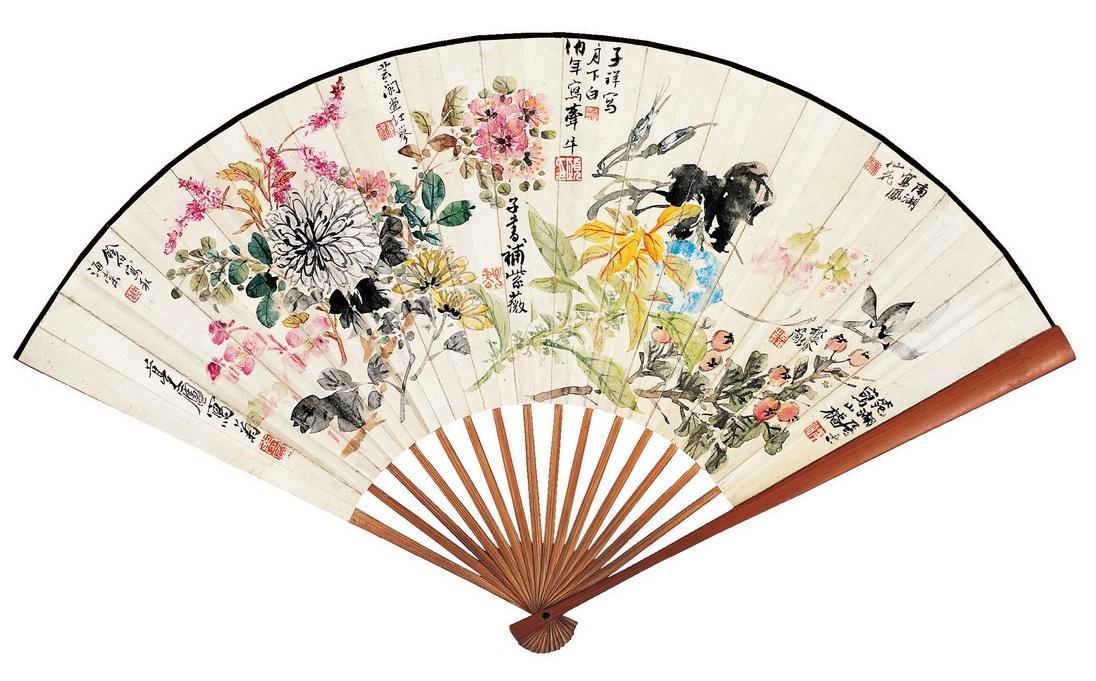
In Mandarin, a Chinese fan is a shànzi (扇子): the folding fan is a zhéshàn (折扇), the round fan a tuánshàn (团扇) and the feather fan a yǔshàn (羽扇). Each name describes the fan's shape — which makes the vocabulary easy to learn.
In this guide, “Chinese fan” refers to the traditional hand fan (扇子) — not fan culture or the surname Fan.
What this guide covers
The outline
01Shàn: the word behind every fan
02Zhéshàn — the folding fan
03Tuánshàn — the round fan
04Yǔshàn — the feather fan
05Regional and literary names
06Frequently asked questions
Section 01
Shàn: the word behind every fan
The everyday Mandarin word for a Chinese fan is shànzi (扇子). The single character 扇 (shàn) already means “fan,” and its shape tells an old story: it is built from 户 (hù), a door, and 羽 (yǔ), a feather — a feather fan by a doorway. The same character is also a verb, shān, meaning “to fan” or “to wave,” so the language itself treats fanning and the fan as one idea.
English speakers usually say “Chinese fan” or “Chinese hand fan,” but Chinese names are more precise: they describe the fan's shape. Once you know that folding fans are zhéshàn, round fans tuánshàn and feather fans yǔshàn, the vocabulary practically explains itself. A general introduction is in our guide to what a Chinese fan is.
Section 02
Zhéshàn — the folding fan
Zhéshàn (折扇) means “folded fan” — 折 (zhé) is the verb “to fold.” This is the collapsible pleated fan of bamboo ribs and paper or silk leaf that scholars kept in their sleeves, earning it the literary nickname 怀袖雅物 (huáixiù yǎwù), “a refined object for the sleeve.”
The Chinese folding fan is the type most people picture when they hear “Chinese fan,” and in English the terms are used interchangeably with “pleated fan.”
Section 03
Tuánshàn — the round fan
Tuánshàn (团扇) means “round fan” — 团 (tuán) is a circle or a round group. These are the fixed, circular fans, usually covered in silk or gauze and mounted on a handle, that appear constantly in Chinese painting of palace women from the Han dynasty onward.
A white-silk round fan is also called a wánshàn (纨扇), after 纨 (wán), fine white silk. The most famous early poem about a fan, written by the Han court lady Ban Jieyu, is precisely about a round silk fan. For the full story, see Chinese round fans.
A round silk fan — tuánshàn (团扇).
Section 04
Yǔshàn — the feather fan
Yǔshàn (羽扇) is the feather fan — 羽 (yǔ) means feather. The best-known version is the goose-feather fan, é máo shàn (鹅毛扇), made famous by the strategist Zhuge Liang, who is almost always painted calmly waving one.
Feather fans read as ceremonial or strategic rather than everyday, which is why they appear in opera, ritual and portraits of generals. Learn more in our guide to Chinese feather fans.
Section 05
Regional and literary names
Beyond the big three, Chinese has a shelf of specific names — most of them just “fan” plus the material:
Chinese
Pinyin
Meaning
蒲扇
púshàn
Palm-leaf fan — the everyday cooling fan
绢扇
juànshàn
Fine-silk fan
檀香扇
tánxiāngshàn
Sandalwood fan
鹅毛扇
é máo shàn
Goose-feather fan
芭蕉扇
bājiāo shàn
Plantain-leaf fan — famous from Journey to the West
Named Chinese fans you are likely to meet
Literary Chinese also calls the folding fan 怀袖雅物 (“a refined object for the sleeve”), and classical texts use poetic terms such as 凉友 (liángyǒu, “cool friend”) for a fan in summer. The material pages — silk, bamboo, paper — each add the vocabulary of their own craft.
Section 06
Frequently asked questions
What is the Chinese word for fan?
The Chinese word for a fan is shàn (扇), and the everyday noun is shànzi (扇子). The same character used as a verb, shān, means “to fan.”
How do you pronounce shàn?
Shàn sounds like “shahn” with a falling fourth tone. In shànzi the -zi is a light, almost neutral syllable: “shahn-dzuh.”
What is a zhéshàn?
A zhéshàn (折扇) is a Chinese folding fan — the collapsible pleated fan with bamboo, sandalwood or wooden ribs and a paper or silk leaf.
What is a tuánshàn?
A tuánshàn (团扇) is a Chinese round fan — a fixed circular fan, usually covered in silk or gauze, mounted on a handle and carried at court from the Han dynasty onward.
What does shànzi mean in English?
Shànzi (扇子) means “fan” or “hand fan” in English. On this site it always refers to the traditional Chinese hand fan, not fan culture or the surname Fan.