Art

Chinese Fan Art

The smallest serious canvas in Chinese art: fans were painted, calligraphed and carried by scholars for centuries. Explore the tradition of Chinese fan art, from Song round fans to Ming literati masterpieces.

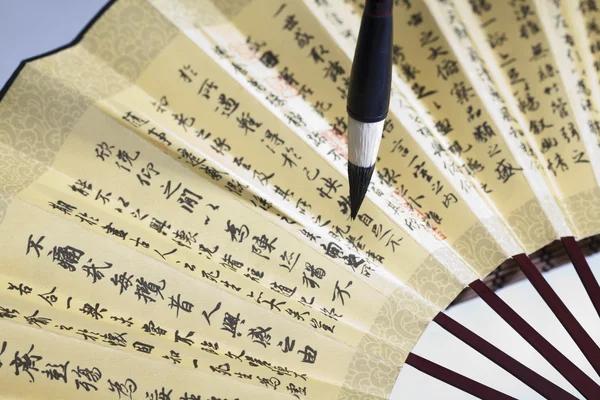
Chinese fan decorated with landscape painting and calligraphy

In this guide, “Chinese fan” refers to the traditional hand fan (扇子) — not fan culture or the surname Fan.

What this guide covers

The outline

  1. 01Why paint on a fan?
  2. 02The literati fan: painting and calligraphy together
  3. 03Famous fan painters
  4. 04Techniques and materials
  5. 05Round fans vs folding fans as canvases
  6. 06Collecting and preserving fan art
  7. 07Frequently asked questions

Section 01

Why paint on a fan?

A fan is the smallest serious canvas in Chinese art. Unlike a scroll or a wall, it fits in one hand, it is carried in public, and it is looked at up close — so painting on a fan is an intimate act between artist and owner. The Ming literati understood this immediately: a fan turned every scholar into a walking gallery.
There is also a practical reason. A painted fan is a gift you can give without wrapping, a keepsake you can carry, and an object that combines two arts — painting and calligraphy — on one surface. That combination is the heart of Chinese fan art: the fan as a complete work of art.
Section 02

The literati fan: painting and calligraphy together

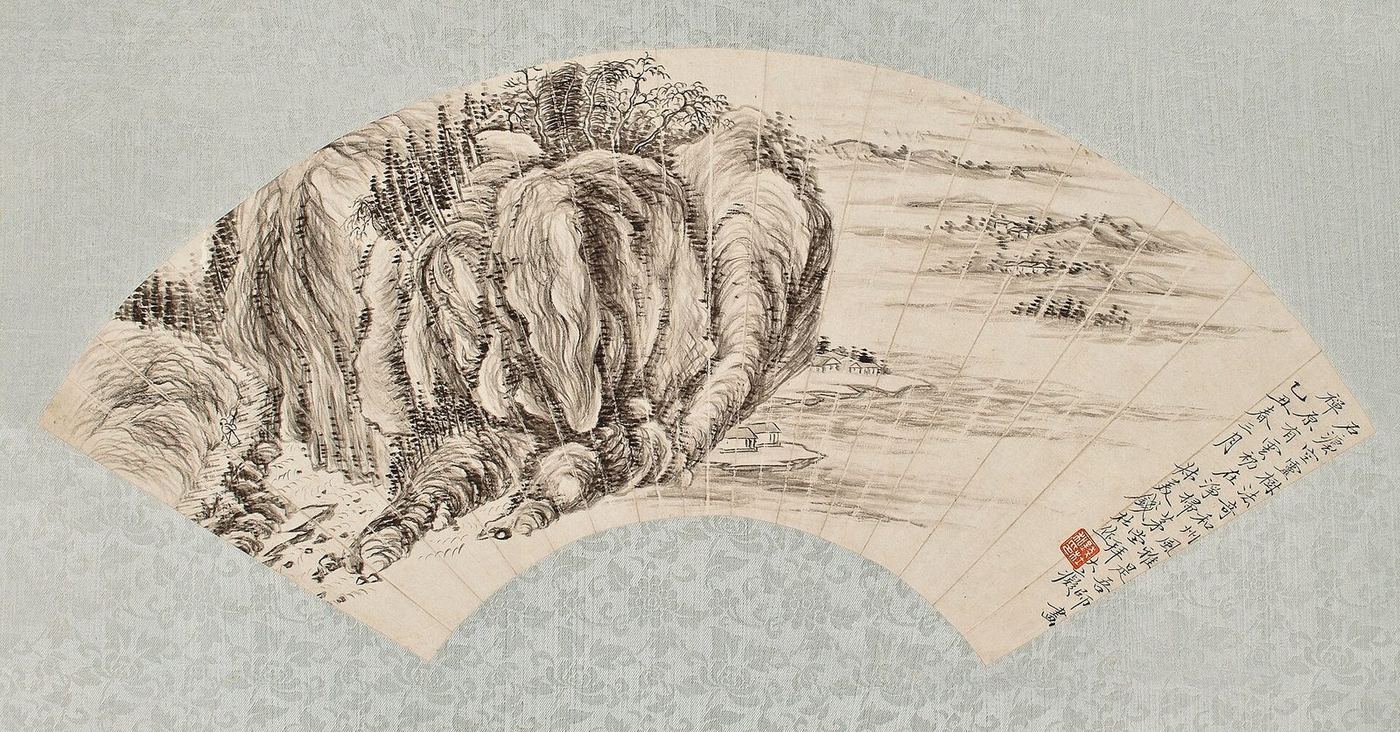
The classic literati fan pairs an image with a poem or phrase. On one side a landscape or a branch of plum; on the other, or in the remaining space, a few lines of calligraphy that answer the image. The result is a miniature of the scholar's ideal: painting, poetry and brushwork in one object.

This is why the history of fan art runs through the Ming dynasty, when painters such as Shen Zhou, Wen Zhengming and Tang Yin treated fan leaves as seriously as scrolls. For the two halves of the tradition, see Chinese fan painting and Chinese fan calligraphy.

Section 03

Famous fan painters

  • Emperor Huizong (Song dynasty) — himself a painter, whose court produced some of the finest surviving round-fan paintings.
  • Shen Zhou (沈周) — Ming Wu School master, known for landscapes and scholarly fans.
  • Wen Zhengming (文徵明) — Ming painter-calligrapher whose fans pair precise brushwork with poetry.
  • Tang Yin (唐寅) — Ming painter famed for figures and elegant, graceful compositions on fans.
  • Dong Qichang (董其昌) — Ming-Qing theorist and calligrapher whose fans shaped later taste.

Museum collections hold thousands of these fan paintings, often detached from their ribs and mounted in albums so they can be studied like prints. That conservation practice is covered in how fan paintings are mounted and kept.

Section 04

Techniques and materials

Fan painting uses the same brush, ink and pigment as scroll painting, but on a demanding surface. Paper or silk must be sized so the ink does not bleed, and the artist works on a small, curved format where every stroke is visible. Two broad styles appear: gongbi (工笔), fine and detailed, and xieyi (写意), loose and expressive — both common on fans.

  • Ink wash (水墨) — the scholar's default; monochrome landscapes and bamboo.
  • Fine brushwork (工笔) — detailed flowers, birds and figures in color.
  • Freehand (写意) — swift, expressive strokes; plum and orchid.
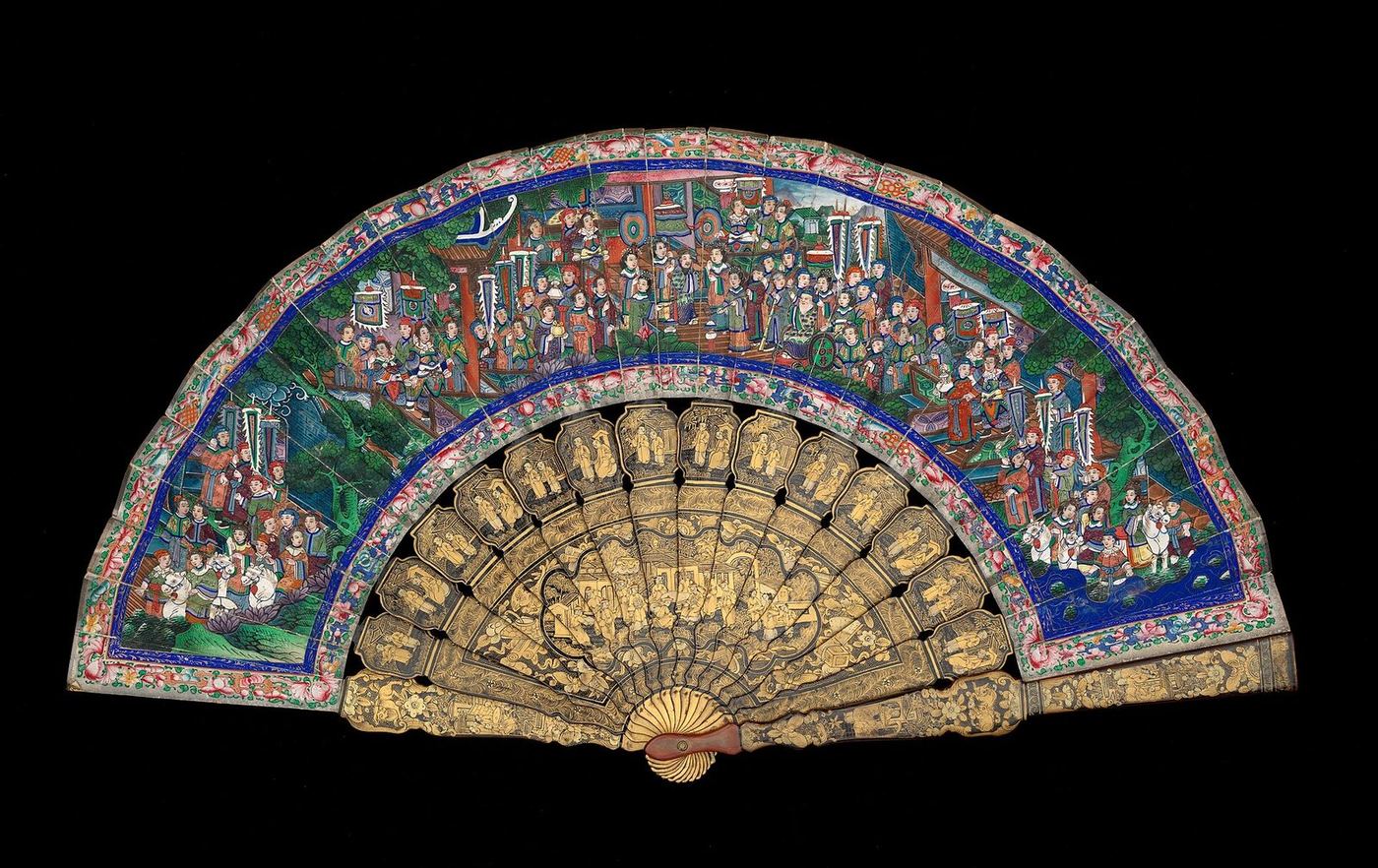
  • Gold and silver grounds — luxury fans for the court and gift market.

Section 05

Round fans vs folding fans as canvases

CanvasShapeBest forComposition
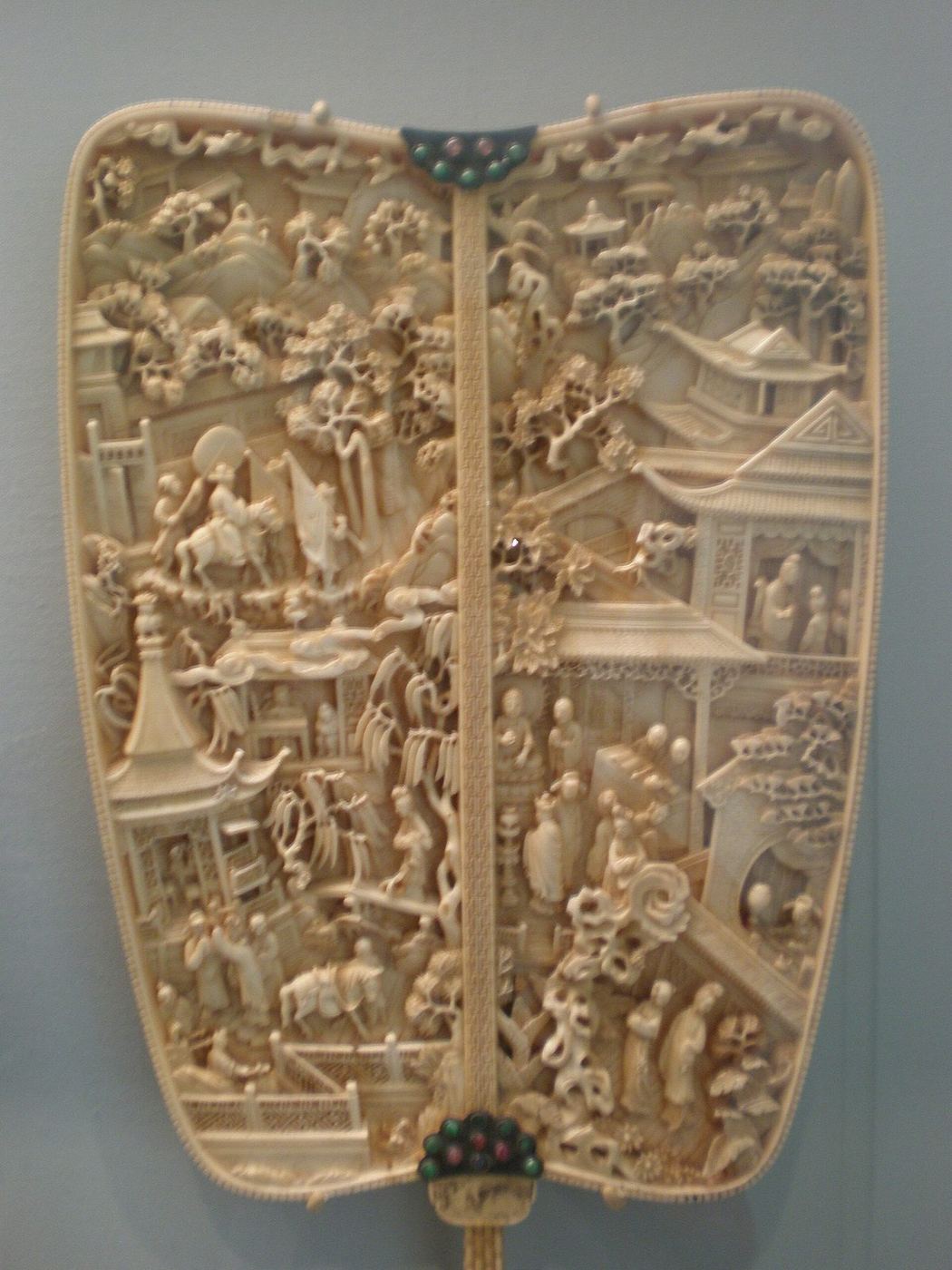
Round fan (tuánshàn)Full circleFlowers, figures, birdsCentered image with space around it
Folding fan (zhéshàn)Arc of 120–180°Landscapes, calligraphyComposition follows the curve; text follows the ribs
How the two main canvases differ

The difference changes the art. A round fan is like a small moon — painters center one subject and leave the rest air. A folding fan's arc invites the eye to travel, which suits landscape, and its pleats organize calligraphy into natural columns. Both traditions are alive in the motif and meaning guides.

Section 06

Collecting and preserving fan art

  • Keep fans closed and flat when stored; paper and silk crease and age in humidity.
  • Avoid direct sunlight — ink and mineral pigments fade.
  • Handle by the ribs, not the leaf; natural oils damage silk and paper.
  • Museum-quality fan paintings are usually mounted into albums (扇面册) for safe study.
  • If a fan is an heirloom, consider professional mounting rather than display in a hot window.

For the collector, the difference between a printed souvenir and a genuine hand-painted fan is the difference between decoration and art. The buyer's side of that line is drawn in authentic Chinese folding fans.

Section 07

Frequently asked questions

Why did Chinese artists paint on fans?

Fans were portable canvases that combined painting, calligraphy and poetry in one intimate object. Scholars carried them in public and exchanged them as gifts, so painting on a fan was both an art and a social act.

Who are the famous Chinese fan painters?

Famous fan painters include Emperor Huizong of the Song, whose court produced fine round-fan paintings, and the Ming masters Shen Zhou, Wen Zhengming, Tang Yin and Dong Qichang.

What is the difference between painting on a round fan and a folding fan?

A round fan is a full circle best suited to a centered subject such as flowers or a figure. A folding fan is an arc that suits landscapes, with composition following the curve and calligraphy following the pleats.

How are fan paintings preserved?

Fan paintings are preserved by keeping fans closed and dry, away from sunlight, and handling them by the ribs. Museum-quality fan faces are often removed and mounted into albums so they can be studied and stored flat.