A Chinese fan dance (扇子舞, shànziwǔ) is any performance built around the fan as its central prop. Dancers open, spin, fold and toss silk fans until the fan seems to become a wave, a blossom, a bird or a brushstroke.
In this guide, “Chinese fan” refers to the traditional hand fan (扇子) — not fan culture or the surname Fan.
What this guide covers
The outline
01What fan dance is
02A short history
03Main styles
04The fans dancers use
05How movement tells meaning
06Learning & performing
07Frequently asked questions
Section 01
What fan dance is
A Chinese fan dance (扇子舞, shànziwǔ) is a performance built around the fan as its central prop. The fan is not decoration held while something else happens. It leads: dancers open it, spin it, fold it and toss it, and the movements of the fan shape the phrases of the dance.
In the Han Chinese folk tradition, the dance is usually performed with a silk folding fan in one hand and a silk handkerchief in the other, or with two fans, one in each hand. The fan is the flexible half of the pair: it can flutter like a butterfly, spread like a flower or cut the air like a blade, while the handkerchief softens and extends the line of the arm.
The same prop works very differently across China's traditions. The Han folk form, the Hani people's ritual palm-fan dance in Yunnan, classical stage dance and the martial tai chi fan are all called fan dances in English, yet they share little beyond the object in the dancer's hand. A good place to see the fan itself in context is the overview of types of Chinese fans.
Section 02
A short history
Dance is one of China's oldest arts. Neolithic pottery from the Yangshao culture of the Yellow River valley, made several thousand years before the common era, already shows people dancing in lines with linked arms. When the fan joined that tradition, nobody wrote it down at the moment it happened, so the early history has to be pieced together from later sources.
The fan that first mattered in performance history was round. The round silk fan (tuánshàn, 团扇) belonged to palace life from the Han dynasty on, and court ladies holding fans appear constantly in later painting. It is no surprise that many introductions trace fan dance back to the Han period. What can be cited precisely is a later written trace: the Song-dynasty writer Yue Shi's catalogue Zhezhi Pu (《柘枝谱》) names a fan dance (扇舞) among the dances of the Jin dynasty, several centuries earlier. The trail of recorded history is thinner than the folklore suggests, but the tradition was old by the time it reached writing.
The round silk fan (tuánshàn) — the court fan whose imagery later choreography still draws on.
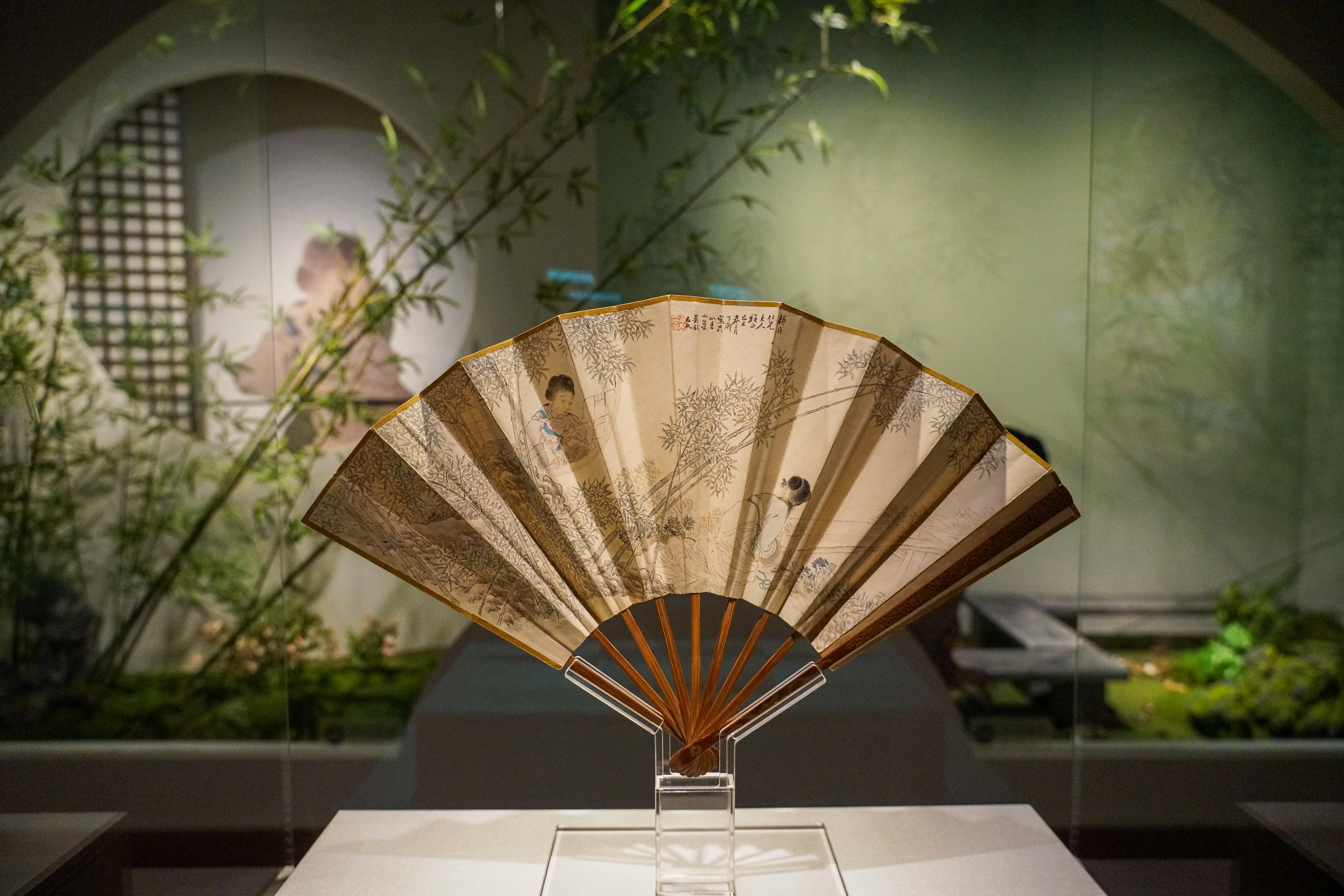
The folding fan changed the dance as much as it changed daily life. Because it opens and closes, it gave dancers a prop with a built-in beat: a snap open, a sharp close, a slow unfurl. Once the folding fan reached China and became the scholar's companion in the Ming dynasty, it also became the performer's favorite. The full arc is told in the history of Chinese fans.
Section 03
Main styles
Fan dance is not one dance. The name covers folk celebration, ritual practice, classical stage repertoire and a martial art, and each tradition holds the fan differently.
Style
Where it lives
Fans you'll see
Shanziwu folk fan dance (扇子舞)
Han communities across China
Silk or paper folding fans, often with a handkerchief in the other hand
Hani palm fan dance
Yunnan's Hani people
Palm-leaf fans that move like wings
Classical stage fan dance
Chinese classical dance (古典舞) repertoire
Silk folding fans; round fans for court roles
Tai chi fan (太极扇)
Tai chi practice, competition and performance
Sturdy folding fans, often metal
A quick map of the main fan-dance traditions
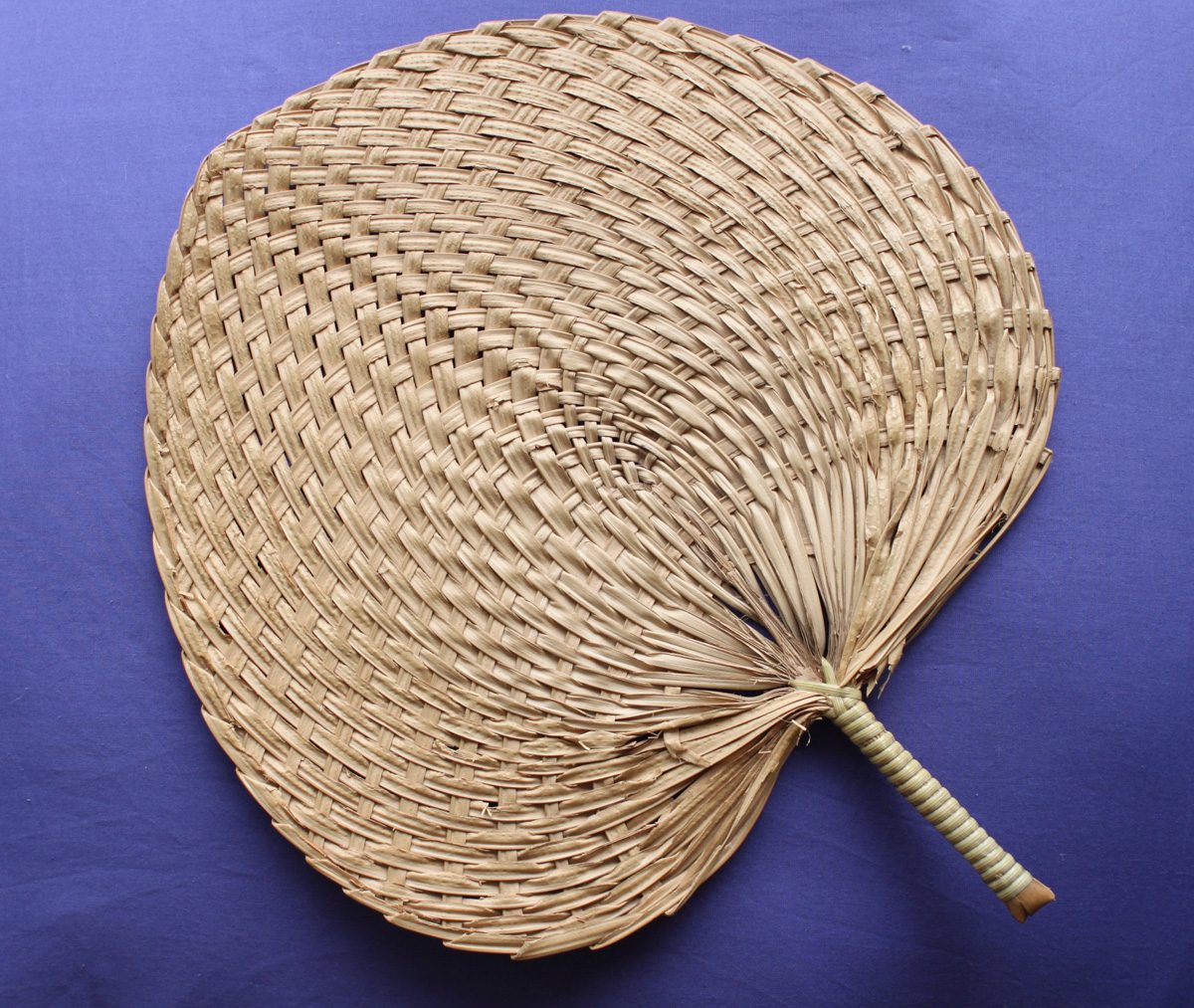
One ritual style deserves a closer look. Among the Hani people of Yuanjiang County in Yunnan, dancers use palm fronds and palm-leaf fans to mimic the wings of the silver pheasant, a bird that in legend saved the Hani ancestors. The dance was once performed when mourning the dead; today it also appears at festivals and celebrations. The mood stays quiet and solemn, closer to prayer than to stage spectacle.
Photo: WikiCantona via Wikimedia Commons (CC BY-SA 3.0)
At the other end of the spectrum is Chinese classical dance, where choreographers have treated the folding fan almost like a writing brush. In the contemporary solo Shanwu Danqing (扇舞丹青, roughly “fan dance in ink and color”), the fan opens, turns and flicks in continuous lines that evoke ink painting and calligraphy. The piece belongs to a wider trend of classical dance that borrows the visual language of Chinese fan painting rather than the customs of the village.
Section 04
The fans dancers use
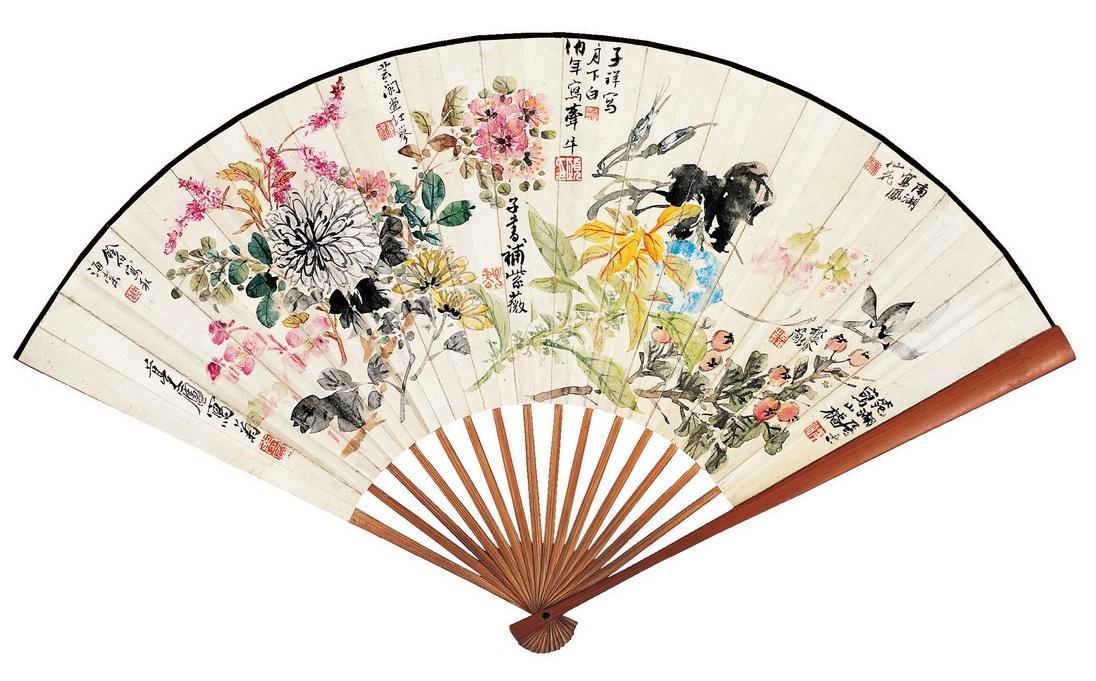
Most stage fan dance today is built around the silk folding fan. Silk catches the light, moves with a softness that paper cannot match, and reads clearly from the back of a large hall. Dancers choose fans that open smoothly and snap shut cleanly, because the fan's mechanics become part of the choreography. That is the same object described in detail on the Chinese silk fan and Chinese folding fan pages.
Image: The Metropolitan Museum of Art via Wikimedia Commons (CC0)
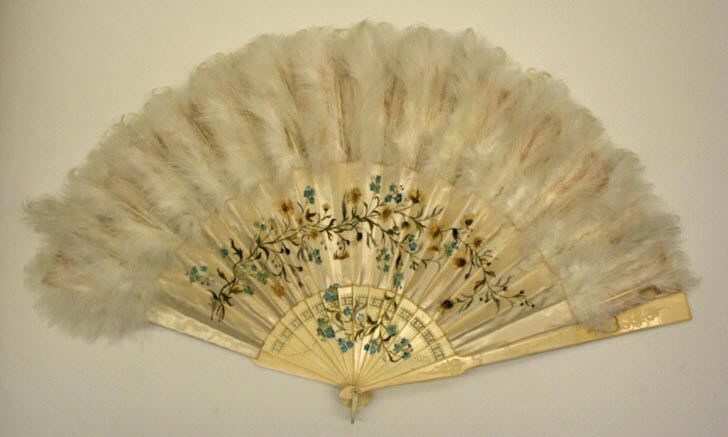
Round silk fans have their own place. When a piece needs the poise of a court lady or the quiet reserve of the boudoir, choreographers often reach for a tuánshàn instead of a folding fan; its fixed circle moves as a whole, which changes the quality of every gesture. Feather fans belong to character roles — the strategist or the immortal — and in performance they make a much broader, slower silhouette than silk. The differences between these families are covered in Chinese round fans and Chinese feather fans.
Practical details matter more than decoration. A dance fan needs a comfortable balance when closed, ribs that stay aligned after repeated opening, and a leaf that will survive being spun and tossed. Many folk troupes favor bright colors precisely because the fan is meant to be read from a distance, not admired up close.
Section 05
How movement tells meaning
The fan extends the dancer's arm and doubles the size of the gesture. Open it quickly and you have punctuated the music; close it sharply and you have ended a phrase. Slow it down and the same object turns soft, because a fan unfolding gradually reads like something opening rather than something striking.
A fan held in front of the face can mean shyness, modesty or concealment — the dancer hides, then lowers the fan to reveal a changed expression.
A fan spun or flicked in a circle can suggest a flower opening, water rippling or a bird taking off; the fan's speed changes which image the audience sees.
A fan moved in long, continuous lines evokes a brush on paper, especially in classical pieces with a calligraphic feel.
A fan snapped open in tai chi marks a cut — the same prop becomes an extension of the hand in a martial sense.
There is no fixed dictionary where one movement always means one thing. The meaning comes from the music, the costume and the sequence around it, which is why the same opening gesture can look flirtatious in a folk piece and resolute in a martial one. That flexibility is part of why the fan appears so often in Chinese fan symbolism — it is an object made to be read in context.
Section 06
Learning & performing
Fan dance is taught at community cultural centers, university dance programs and Chinese dance schools, and in recent years it has spread through online classes and short videos. The distance between watching and doing is not as large as it looks, provided you start with the fan itself.
Learn to open and close the fan cleanly before adding footwork. Most beginner mistakes happen when the hand is still learning the fan.
Choose a silk folding fan that opens smoothly and feels balanced when closed; a fan that fights you will show up in every movement.
Practice in open space. A fan dance is bigger than it feels from inside, and ceilings and furniture get in the way.
Follow a teacher or a structured class for group formations; video is a useful reminder, but a good eye on the floor catches what a camera does not.
For tai chi fan, start with the basics of tai chi itself and let an instructor introduce the fan, since the snapping movements need space and control.
The handling basics — grips, opening technique and the movements worth practicing — are covered step by step in how to use a Chinese fan and how to hold a Chinese fan. When you are ready to own a performance fan rather than borrow one, the buying questions are the same as for any handmade Chinese folding fan: check the ribs, the balance and the quality of the silk before you fall for the color.
Section 07
Frequently asked questions
What is Chinese fan dance?
Chinese fan dance (扇子舞, shànziwǔ) is a dance form in which the fan is the central prop. Dancers open, spin, toss and fold fans so the movement of the fan becomes part of the choreography, and the fan can suggest flowers, birds, waves or brushstrokes.
What fans do Chinese dancers use?
Stage fan dance most often uses silk folding fans, which catch the light and open with a clean snap. Round silk fans appear in classical pieces for court-lady roles, palm-leaf fans are used in Hani ritual dance in Yunnan, and tai chi fan practice uses sturdy folding fans, often made of metal.
Is Chinese fan dance hard to learn?
The basics are approachable: opening and closing the fan cleanly, holding it correctly and learning a simple sequence. Group choreography and performance polish take practice and usually a teacher, but beginners can make real progress quickly if they start with the fan handling before the footwork.
Where can I watch Chinese fan dance?
Fan dance appears in Chinese cultural performances, festivals and dance competitions, and it is widely shared as short video. Classical works and tai chi fan routines are also common in Chinese dance programs and cultural showcases outside China.
What does a fan symbolize in Chinese dance?
In dance, a fan often stands for grace, poise and an extension of the dancer's reach. Its meaning changes with the movement: hiding behind a fan suggests modesty, a spinning fan can suggest a flower, and a sharp open in tai chi marks a cut. The symbolism depends on context rather than a fixed dictionary.
Is fan dance the same as tai chi fan?
No. Folk and classical fan dance treat the fan as a visual prop that extends the dancer's lines and shapes the music. Tai chi fan is a martial-arts form in which a sturdy folding fan is used as an extension of the hand in techniques, with opening and snapping movements tied to tai chi practice.